
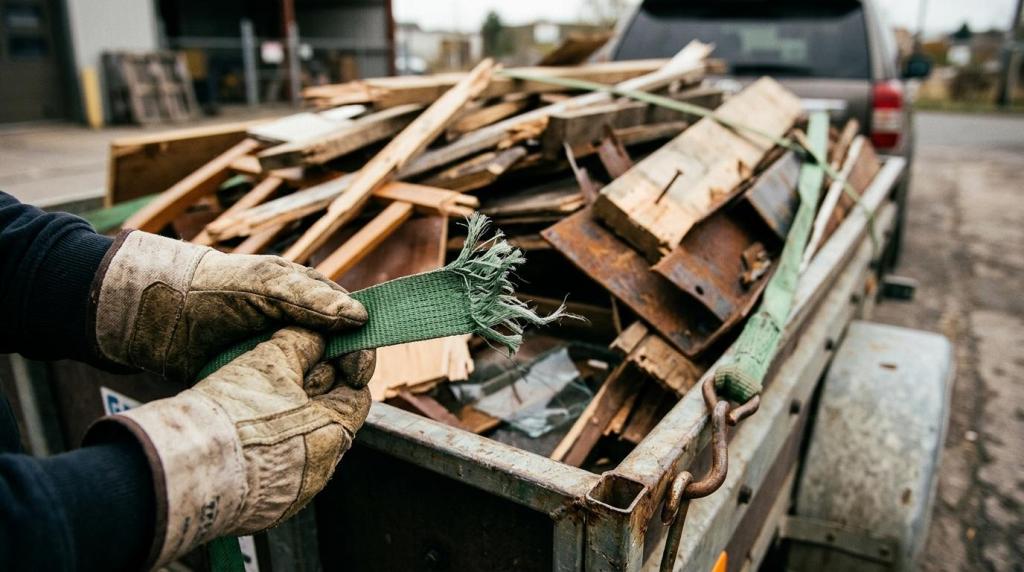
A DIY tip run can look like the cheaper option. You load the trailer, pay at the gate, and get on with your day. Simple enough.
The trouble is that rubbish rarely stays simple once the pile gets bigger, heavier, or more mixed. Fuel, landfill charges, trailer hire, vehicle wear, loading time, queueing, and the risk of injury can turn a “cheap” clean-up into a long and costly job. That gap becomes even sharper when the work involves a deceased estate, a home being prepared for sale, or a leased office that needs to be cleared by a deadline.
Professional rubbish removal makes the cost visible at the start. DIY tip runs often hide the real bill until the day is over.
Real cost comparison: professional rubbish removal vs DIY tip runs
Most professional rubbish removal services charge by volume, often by cubic metre or truckload. Industry guides commonly place household clean-up rates somewhere around A$50 to A$150 per cubic metre, with metro markets often sitting in the middle of that range. In many cases, that fee includes labour, transport, and disposal.
DIY looks cheaper because there is no service invoice. Yet the direct costs still stack up. A small return trip may only use a few litres of fuel, but tipping fees can rise quickly once weight is involved. Some councils charge modest amounts for light loads, then jump sharply for heavier mixed waste. Add trailer hire, tie-down gear, gloves, and your own time, and the savings can shrink fast.
Heavy waste changes the picture even more. Renovation debris, wet timber, old furniture, books, soil, and broken appliances can weigh far more than people expect. A load that seems manageable at home can become expensive at the weighbridge.
Here is a practical side-by-side example for a mixed 5 m³ clean-up.
| Item | Professional rubbish removal | DIY tip run |
|---|---|---|
| Labour | Included | Your own time and effort |
| Truck or transport | Included | Your vehicle, ute, or hired trailer |
| Disposal charges | Usually included | Paid per trip, often by weight |
| Fuel | Included in quote | Multiple return trips |
| Trailer hire | Not needed | Often A$50 to A$120 per day |
| Estimated user time | 30 to 60 minutes on site | 4 to 6 hours across several trips |
| Typical total for 5 m³ mixed waste | Often A$300 to A$800 | Can range from modest to similar or higher once all costs are counted |
That does not mean DIY never wins on price. If you have one small, light load, your own trailer, and a nearby tip, it can still be the cheapest route. The tipping point usually arrives when the volume grows past a single easy trip.
Time commitment: what a tip run really asks of you
Time is the cost people forget most often.
A professional crew can often clear a moderate pile in under an hour because the truck, labour, and lifting gear arrive together. You point out what needs to go, confirm the quote, and the waste is taken away. Your role is small.
DIY is slower because every step belongs to you, and most jobs involve double handling. You lift the waste once to load it, then lift or drag it again at the tip to unload into separate bays. If the tip requires sorting into metal, green waste, hard waste, mattresses, e-waste, or general waste, the process slows further.
A typical DIY run often includes all of the following:
- Loading: lifting, sorting, stacking, and securing the load
- Driving: the return trip, traffic delays, and fuel stops
- Queueing: waiting at the gate or weighbridge
- Unloading: moving items again into the correct disposal areas
That may not sound like much on paper. In practice, one trip can swallow two hours. Three trips can take most of a day.
For time-poor families, interstate relatives managing a property from afar, or sellers racing to list a home, that time cost can be more important than the disposal fee itself.
Safety and legal risk: the part many people underestimate
Rubbish removal is physical work, and physical work carries risk. The common hazards are not dramatic. They are familiar, ordinary, and easy to underestimate until someone strains a back or drops a wardrobe on a foot.
Manual handling injuries are among the most common problems in waste removal. Old lounges, whitegoods, timber offcuts, filing cabinets, and boxes of books can all be awkward rather than obviously heavy. That awkwardness is what causes trouble. Twisting, lifting alone, dragging items downstairs, or reaching into a trailer can put real pressure on the lower back and shoulders.
Cuts and punctures are another issue. Mixed piles often hide broken glass, rusted metal, nails, splintered timber, and sharp edges. Then there is the transport risk. An overloaded or poorly secured trailer can shift in transit, spill debris, or destabilise the vehicle.
The personal risks are usually one or more of these:
- Back strain and shoulder injuries
- Cuts from glass, metal, and hidden nails
- Trips and falls during loading
- Vehicle instability from unsecured loads
- Damage to your car, ute, or trailer
There is also the legal side. Not all waste belongs in general landfill. Items like asbestos, chemicals, some electronics, tyres, gas bottles, and certain construction materials can require separate handling or specialist disposal. If banned or regulated items are mixed into a general load, the person delivering them may be refused, charged extra, or exposed to penalties.
Professional operators do not remove all risk, though they reduce a large part of it for the customer. Trained crews use team lifting, trolleys, ramps, gloves, boots, and load restraint systems. They also know how local disposal rules work, which matters when a clean-up includes more than old household junk.
When DIY tip runs still make sense
DIY is not the wrong choice. It is often the sensible one for a specific type of job.
If the waste is light, limited, and easy to handle, a tip run can be economical and straightforward. A few bags of green waste, small broken household items, flattened cardboard, or a single piece of furniture may be worth doing yourself, especially if the tip is close by and your vehicle suits the job.
DIY tends to work best when the conditions are already in your favour.
- Small load
- Short drive to the tip
- Suitable trailer or ute
- Good physical capacity
- Flexible weekend time
It also helps if the waste is sorted before loading. Clean green waste, scrap metal, and cardboard are much easier to deal with than a mixed pile from a shed clean-out or deceased estate.
Where people often get caught is assuming a medium job is still a small job. One spare room, one garage, or one cluttered patio can fill far more trailer space than expected.
When professional rubbish removal becomes the smarter option
Once rubbish becomes bulky, heavy, urgent, or emotionally difficult, the value of a professional service becomes much clearer.
This is especially true in deceased estates. Families are often balancing grief, time pressure, legal administration, and distance. The last thing they need is repeated tip runs, heavy lifting, and guesswork about disposal rules. The same applies to home sellers trying to present a property well for photography and inspections, or businesses clearing premises at the end of a lease.
In those situations, a professional team is not only removing rubbish. They are removing friction.
The strongest reasons to book a service are usually these:
- Volume: more than one easy trailer load
- Weight: appliances, furniture, timber, rubble, or packed boxes
- Speed: a sale, settlement, or lease deadline
- Access: stairs, tight spaces, side yards, or difficult garages
- Compliance: mixed waste, e-waste, mattresses, or other restricted items
- Physical limits: when the people involved should not be lifting at all
There is also a practical quality difference. A good operator arrives with labour and a truck ready to go. That matters when the work needs to be discreet, efficient, and respectful. In South Australia, services like HandiLoad are often used in exactly these scenarios because they can supply labour, trucks, hard waste removal, and skip bins without pushing the physical burden back onto the client. For homes being prepared for sale, that single booking can save days of piecemeal effort.
Some jobs also sit just beyond “rubbish removal”. A property may need a clear-out, then garden clean-up, then minor preparation work before listing. When one provider can support more than the initial rubbish haul, the process becomes easier to manage.
A fixed quote also has value. People often accept visible cost more easily than hidden cost. With a clear scope and collection time, you know what the job will take. With DIY, the bill often keeps changing with every extra trailer load.
For many households, the decision comes down to this: if the job fits in one safe, simple run, doing it yourself can be fine. If it needs multiple trips, heavy lifting, fast turnaround, or careful handling, professional rubbish removal is usually the more efficient and lower-risk choice. And when a property needs to be cleared with care, speed, and discretion, that choice can save far more than money.
Recent Comments