
Rubbish removal costs in Australia can vary far more than many people expect. A small pile of mixed household waste may be a modest call-out, while a packed garage, heavy renovation debris, or a deceased estate clean-out can climb quickly once labour, access, and disposal fees are added.
That variation makes sense when you look at the volume of waste Australian households generate. National reporting shows municipal solid waste from households and local government activities reached 13.5 million tonnes in 2022 to 2023, or about 512 kg per person. When that waste needs to be cleared fast, safely, and lawfully, the price is shaped by more than just how many bags are sitting by the fence.
Typical rubbish removal prices in Australia
The broad market guide for standard domestic rubbish removal is often quoted by volume or by time. Industry pricing guides place domestic rubbish removal at roughly $50 to $150 per cubic metre, while hourly rates can start from about $35 per hour and average around $100.89 per hour. One industry guide also puts the average total job cost at about $347.
Those figures are useful as a starting point, not a promise. They usually reflect ordinary household waste and basic access conditions. Once a job involves dense materials, difficult loading, long carrying distances, or regulated waste, the price can move well beyond those averages.
Here is a practical snapshot of common market guides.
| Job or pricing style | Indicative cost guide | Notes |
|---|---|---|
| Domestic rubbish removal | $50 to $150 per cubic metre | Broad guide for household waste |
| Household waste | $50 to $130 per cubic metre | Often used for mixed general waste |
| Green waste | $5 to $130 per cubic metre | Wide range because weight and contamination vary |
| Brick or rubble removal | $8 to $270 per cubic metre | Dense materials cost more to load and dispose of |
| Hourly labour | From $35 per hour | Low-end starting point only |
| Average hourly rate | About $100.89 per hour | Reported market average |
| Average total job | About $347 | Typical overall guide, not a cap |
A minimum charge is also common, especially for small jobs. If a crew must travel across town, load the truck, and pay disposal fees, even a quarter-load may still attract a base rate that feels higher than the volume alone would suggest.
Common rubbish removal pricing models
Not every provider prices the same way. Some charge by cubic metre, some by the hour, and some offer a fixed total quote after seeing photos or visiting the site. Market data suggests hourly charging is the most common approach, with a smaller share using per-cubic-metre pricing or a fixed total quote.
That matters because the best pricing model depends on the job. A neat pile on a driveway is easy to measure by volume. A cluttered shed, office strip-out, or pre-sale clear-out is often harder to scope until work begins.
- Hourly quoting: often suits mixed clean-ups where the final volume is uncertain
- Per cubic metre quoting: useful when the pile can be measured clearly
- Fixed total quote: common when photos or a site visit make the job easy to price
If two quotes look very different, check whether one is labour-only and the other includes disposal fees, travel, and GST. A lower headline number does not always mean a lower final invoice.
What moves rubbish removal quotes up or down
Four things drive most rubbish removal prices: volume, waste type, access, and disposal rules. In many jobs, these factors overlap.
A light trailer-sized load of cardboard and old toys is usually quicker and cheaper to clear than a half-load of concrete, soaked timber, or broken tiles. A team can fill a truck with light waste quite fast, while a much smaller pile of dense waste may take longer to carry, load, and tip.
Access is another major factor. If the truck can reverse close to the pile, labour time drops. If workers must carry items down stairs, through a long hallway, around a steep block, or out of a backyard with no side gate, the quote rises.
- Volume of rubbish
- Weight and density
- Number of workers needed
- Distance from pile to truck
- Stairs, lifts, narrow paths
- Travel time and disposal time
A full room of cardboard can be cheaper than half a pile of broken concrete.
Waste type, landfill levies and disposal fees
Waste type often has the biggest effect after volume. General household rubbish is usually straightforward. Hard waste, green waste, furniture, whitegoods, mattresses, e-waste, bricks, soil, and mixed renovation debris each follow different disposal paths, and each path has its own cost.
This is where landfill levies start to matter. State-based levies are charged to discourage landfill and encourage recycling or resource recovery. In New South Wales, for 2026 to 2027, the waste levy is set at $180.20 per tonne in the Metropolitan Levy Area and $103.80 per tonne in the Regional Levy Area. Other states and territories have their own systems, and those costs often flow through to rubbish removal quotes.
The result is simple enough. The heavier the load, and the more restricted the disposal route, the more expensive the job tends to be. Dense mixed waste can cost more than light mixed waste even when both take up the same space in a truck.
Contamination also matters. A green waste load that is clean and separated is easier to process than a pile mixed with plastic, treated timber, pots, and general rubbish. The same applies to office and commercial clean-outs. Sorted waste streams often cost less to dispose of than unsorted mixed waste.
For home sellers and executors preparing a property for sale, this is one reason full-service clear-outs can vary so widely. Two homes may have the same number of rooms, yet one may contain mostly furniture and bagged rubbish while the other includes old paint, broken fencing, scrap metal, mattresses, and a garage full of heavy shelving.
Hazardous waste and asbestos removal costs
Hazardous waste is where cheap quotes can become risky quotes.
Some items cannot be loaded with ordinary rubbish and taken to a standard landfill stream. Batteries, chemicals, oils, e-waste, and refrigeration units often require separate handling. That can mean more sorting time, different transport rules, and extra disposal fees.
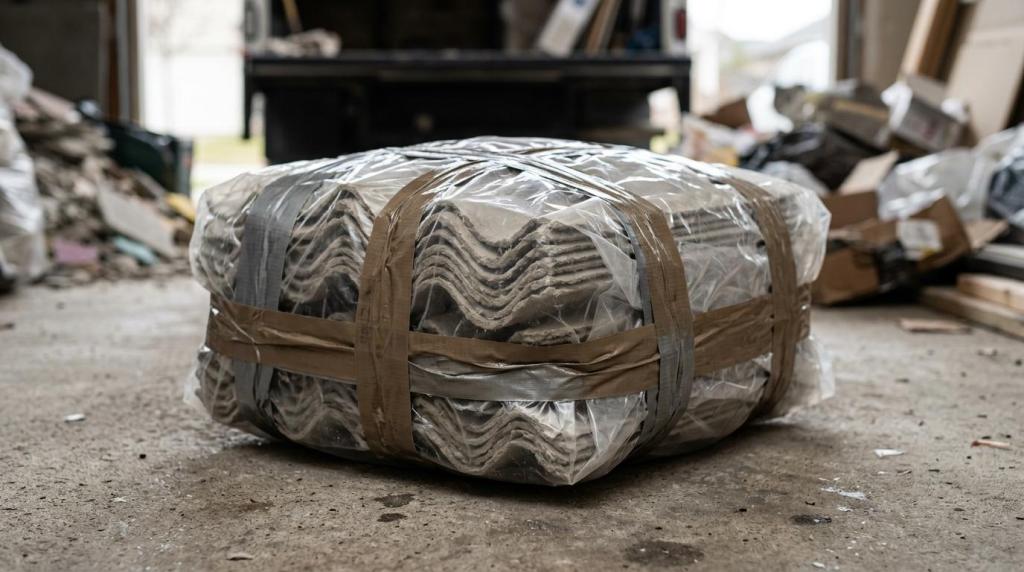
Asbestos is the clearest example. Safe Work Australia states that a licence is required to assess or remove asbestos. Although asbestos was banned in Australia in December 2003, it can still be found in older homes and buildings, including fibrous cement sheeting, roofs, gutters, and other products. If a property was built or renovated decades ago, suspicious materials should never be treated as normal hard waste.
EPA Victoria also notes that more hazardous waste types cost more to dispose of, and that waste classification can change where waste is allowed to go. Even where asbestos waste attracts a different levy setting, licensed handling, wrapping, transport, and approved disposal still add significant cost.
- Asbestos: licensed assessment or removal may be required, with strict handling and approved disposal
- Batteries and e-waste: separate recycling streams can add labour and processing costs
- Paints, chemicals and oils: these cannot simply be mixed into general rubbish
- Fridges and air conditioners: specialist treatment may apply before disposal
If a quote seems unusually low and the job includes possible hazardous materials, ask exactly how those items will be handled. A proper answer should be clear and specific.
Access, labour and property conditions
Access is often the hidden line item.
Rubbish removal is part transport job and part manual labour job. A simple kerbside pickup can be very efficient. A third-floor unit with no lift, no loading zone, and bulky furniture is a different exercise entirely.
Labour costs rise when crews need to sort loose items, bag scattered waste, dismantle furniture, cut up fencing, or clear packed rooms one item at a time. This is often the case with deceased estates, hoarding situations, end-of-lease office clearances, and homes being preparing a property for sale.
Timing can also affect price. Urgent jobs, same-day requests, or work that must fit around settlement dates and property inspections can cost more. So can jobs in remote areas where travel and tip runs take longer.
For interstate family members organising a clearance from a distance, the most useful quote is often not the cheapest one on paper. It is the one that clearly covers labour, lifting, loading, disposal, and site conditions without leaving major extras to be added later.
Skip bins versus hands-on rubbish removal
A skip bin can be the lower-cost option when there is enough space on site, the waste type is suitable, and the household or business can do the loading. It can also work well when the clean-up will happen over several days.
Hands-on rubbish removal often makes more sense when the waste is already piled up and needs to go quickly, when heavy lifting is not practical, or when there is no time to sort, load, and organise disposal. It is also well suited to sale preparation, deceased estates, office vacates, and situations where discretion matters.
There is also a practical point many people miss. With a bin, you still carry the labour yourself. With a removal crew, labour is part of the service. That difference is often what clients are really paying for.
How to get an accurate rubbish removal quote
The easiest way to avoid surprise costs is to give clear information early. Good photos, a rough idea of volume, and an honest list of special items can make the quote far more reliable.
If the job includes old building materials, state that clearly. If access is tight, mention stairs, narrow gates, apartment lifts, or long carry distances. If the property is being prepared for sale, say whether the service is just rubbish removal or also includes a more complete clear-out.
- Send clear photos: include wide shots and close-ups
- Approximate cubic metres
- Declare special items: mattresses, tyres, televisions, batteries, paints, whitegoods, or anything that may contain asbestos
- Access details, parking, stairs, and distance from the rubbish to the truck
It is also worth asking whether the quote is hourly, volume-based, or fixed, and whether disposal fees are included. When those details are clear, it becomes much easier to compare providers on value rather than just the first number you see.
Recent Comments